Pilots reported ice, turbulence and a dangerous loss of altitude before the private jet crashed in Palm Beach County, leaving nine dead and hundreds of residents displaced. Federal investigators are searching for answers.
By Staff Editor | The Texas Countryman
November 1, 2026 | Updated Sunday Evening
PALM BEACH COUNTY, Fla. — A private business jet that departed Austin, Texas, for the Bahamas crashed into a South Florida residential neighborhood Sunday afternoon, November 1, killing all nine people aboard after its pilots reported turbulence, ice accumulation and an alarming loss of altitude.
The aircraft, identified as a Learjet 60, went down at approximately 12:50 p.m. Eastern Time near Military Trail and 10th Avenue North in Palm Beach County, in the Greenacres and Cresthaven area.
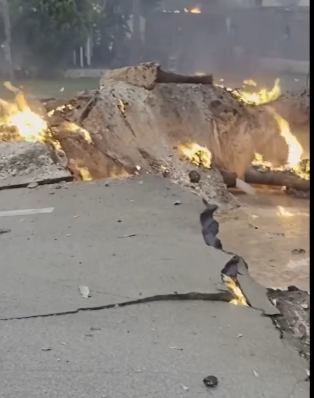
The crash occurred near a busy roadway and residential properties, where witnesses watched the aircraft descend at extreme speed before striking the ground and erupting into a massive fireball.
The impact left a large crater, scattered wreckage across the surrounding area and forced emergency responders to evacuate hundreds of nearby residents.
U.S. Transportation Secretary Sean Duffy confirmed the deaths of all nine people aboard the aircraft, describing the accident as a horrific tragedy.
The Federal Aviation Administration (FAA) and National Transportation Safety Board (NTSB) have launched an investigation into what caused the jet to crash.
From Austin, Texas, to the Bahamas: The Flight That Never Arrived
According to the FAA, the Learjet 60 departed Austin-Bergstrom International Airport in Texas and was traveling to North Eleuthera Airport in the Bahamas.
The flight was supposed to carry its occupants across the southeastern United States and toward the Caribbean.
Instead, the aircraft encountered trouble while flying over South Florida.
Preliminary reporting indicates the jet was traveling east at approximately 35,000 feet when the flight crew reported difficult atmospheric conditions, including turbulence, precipitation and ice accumulation.
The pilots requested permission to climb another 2,000 feet, to approximately 37,000 feet, apparently seeking improved flying conditions.
However, shortly afterward, the aircraft began an extraordinarily rapid descent.
The timing between the reported weather difficulties and the aircraft’s loss of altitude has become one of the central questions surrounding the disaster.
Investigators have not concluded that weather caused the crash.
Final Moments: A Desperate Emergency in the Sky
One of the most troubling aspects of the accident involves the reported communications between the pilots and air traffic controllers.
According to aviation radio recordings described by national news organizations, a pilot initially informed controllers that ice was accumulating on the aircraft but remained manageable.
The crew also reported moderate turbulence.
The situation deteriorated rapidly after the request to climb.
Flight-tracking information and reported air traffic control communications indicate that the aircraft began descending at thousands of feet per minute.
The pilot reported an emergency as the descent rate increased dramatically, eventually reaching approximately 20,000 feet per minute in a radio transmission.
Additional flight-tracking data suggested an even greater descent rate during the aircraft’s final moments.
The crew also reported an overspeed condition, indicating that the jet had accelerated beyond a safe operating range.
The final transmissions reflected the pilots’ recognition that they were rapidly approaching the ground.
Shortly afterward, the aircraft disappeared from flight-tracking systems and struck the ground in Palm Beach County.
Investigators will need to establish whether the aircraft experienced an aerodynamic stall, a loss of control, equipment malfunction, severe atmospheric disturbance or some combination of factors.
Those possibilities remain investigative questions, not established explanations.
How Fast Was the Jet Falling?
The reported descent rates are among the most striking details of Sunday’s accident.
Commercial and business aircraft normally descend in a controlled manner, often at rates measured in hundreds or a few thousand feet per minute, depending on the phase of flight.
A reported descent of 20,000 to 30,000 feet per minute is dramatically different from a normal descent.
At 30,000 feet per minute, an aircraft would lose approximately 500 feet of altitude every second.
That figure describes vertical descent rate, not total airspeed. It does not by itself establish the aircraft’s exact speed at impact.
CNN reported that flight-tracking information indicated the Learjet lost approximately 27,000 feet of altitude in about one minute before tracking data ended.
Investigators must validate those measurements against radar records, aircraft data and other evidence.
The extreme descent raises important questions about whether the pilots could control the aircraft’s attitude and speed during the emergency.
Aircraft Icing: Why Investigators Will Examine the Weather
The crew’s reported encounter with icing conditions is likely to receive significant investigative attention.
Aircraft icing occurs when supercooled water droplets freeze on exposed aircraft surfaces.
Ice can accumulate on wings, tail surfaces, sensors and other equipment under certain atmospheric conditions.
This can interfere with airflow and reduce an aircraft’s aerodynamic performance.
Depending on the severity and location of the accumulation, icing may increase drag, reduce lift or affect the accuracy of certain flight instruments.
Modern business jets are designed with systems intended to help prevent or remove ice in approved operating conditions.
However, investigators will need to determine whether those systems were functioning properly and whether the aircraft encountered conditions beyond its expected operating environment.
Icing alone cannot be assumed to have caused the Learjet crash.
The NTSB will also examine the aircraft’s flight path, control inputs, weather radar information, maintenance records and the sequence of events immediately preceding the emergency.
Severe Weather Across South Florida
Rain and thunderstorms affected portions of South Florida on Sunday.
The National Weather Service had issued a flood watch as heavy rainfall threatened parts of the region.
Reports indicated that the aircraft had passed through an area of stronger storm activity shortly before its rapid descent.
Turbulence associated with storm systems can produce abrupt changes in an aircraft’s movement, particularly when convective weather is present.
Investigators will examine how the aircraft’s route intersected with the weather, including whether the crew attempted to avoid areas of turbulence or icing.
They will also evaluate the weather information available to the pilots before and during the flight.
The presence of severe weather does not, by itself, establish the cause of the accident.
Crash Site: Fireball, Debris and Damage Near Homes
The jet crashed near Military Trail, a major roadway running through Palm Beach County.
Video recorded by motorists showed the aircraft falling toward the ground before an explosion sent flames and smoke into the air.
The impact created a crater and scattered debris near residential properties and passing traffic.
Emergency crews from Palm Beach County Fire Rescue and local law enforcement responded to the accident scene.
Firefighters worked to address fires and secure the debris field, while deputies closed surrounding roads.
Authorities shut down Military Trail between Cresthaven Boulevard and 10th Avenue North.
Officials urged drivers to avoid the area to allow emergency vehicles and investigators to operate safely.
Florida Gov. Ron DeSantis visited the crash scene and described the destruction as cataclysmic.
Despite the crash occurring close to homes and vehicles, officials reported no confirmed injuries or deaths on the ground during the initial response.
Approximately 600 Residents Evacuated
The crash had consequences beyond the loss of the nine people aboard the aircraft.
Palm Beach County authorities reported that approximately 600 people were being evacuated from a nearby mobile home community as emergency personnel secured the area.
Residents faced disruption as emergency crews addressed fires, debris, potential hazards and access restrictions.
The size of the debris field and proximity to nearby residences complicated the response.
Officials worked to provide temporary shelter and assistance to residents displaced by the accident.
The location will require extensive examination before investigators and local authorities can determine when affected areas may safely reopen.
What Do We Know About the Aircraft?
The Learjet 60 is a twin-engine business aircraft associated with Bombardier’s Learjet family.
It is designed for high-speed executive and private travel and is capable of operating at high cruising altitudes.
Unlike large commercial airliners, business jets such as the Learjet 60 typically operate with smaller flight crews and carry a limited number of passengers.
The aircraft involved in Sunday’s crash had been operating as a private flight, according to reporting from Austin-Bergstrom International Airport.
CNN reported that FAA registration information listed the aircraft under a Delaware limited liability company and that the jet had been advertised as available for charter.
However, the registration alone does not establish who chartered the aircraft, who paid for the trip or the identities of those aboard.
Those details had not been publicly confirmed Sunday evening.
Federal Investigation: What Happens Next?
The National Transportation Safety Board will lead the investigation into the crash, supported by the FAA.
Investigators will examine the wreckage, document the impact site and work to reconstruct the flight’s final moments.
Critical areas of examination are expected to include:
- Flight-tracking and air traffic control data: Reconstructing the route, altitude changes, speed and emergency communications.
- Weather: Determining the actual icing, precipitation and turbulence encountered along the flight path.
- Aircraft systems: Examining engines, flight controls, anti-icing equipment and other systems for signs of malfunction.
- Maintenance history: Reviewing past inspections, repairs and aircraft operating records.
- Crew qualifications and actions: Evaluating training, experience, operational decisions and responses to the reported emergency.
- Physical evidence: Studying recovered components to determine whether failures occurred before impact or resulted from the crash.
Investigators will also determine which onboard recording systems, if any, were installed and whether usable data survived the accident.
A preliminary NTSB report may provide an initial factual timeline, but establishing the probable cause of an aviation accident typically requires a much longer investigation.
Nine Lives Lost, Many Questions Unanswered
As of Sunday evening, officials had not publicly identified the nine people killed in the accident.
Authorities had also not released a complete breakdown of passengers and crew.
The tragedy has drawn national attention because of the number of fatalities, the aircraft’s Texas departure, the reported midair emergency and the crash’s proximity to a populated neighborhood.
For families awaiting information, the most immediate concern remains the identification of those who died and notification of their loved ones.
For aviation investigators, the central questions are technical but equally important: What caused a business jet at cruising altitude to enter such a rapid descent, and could the accident have been prevented?
Those answers will depend on the evidence collected in the weeks and months ahead.
The Texas Countryman will continue following developments involving the aircraft, its Texas departure, the victims and the federal investigation.
Editor’s Note: This article reflects information reported on November 1, 2026. Details concerning the aircraft’s final descent are based on preliminary flight-tracking information and reported air traffic control communications. The NTSB has not established an official probable cause. The article will be updated as federal investigators release verified findings.